Dash.DevLabs Copilot: bringing AI to environmental monitoring on construction sites
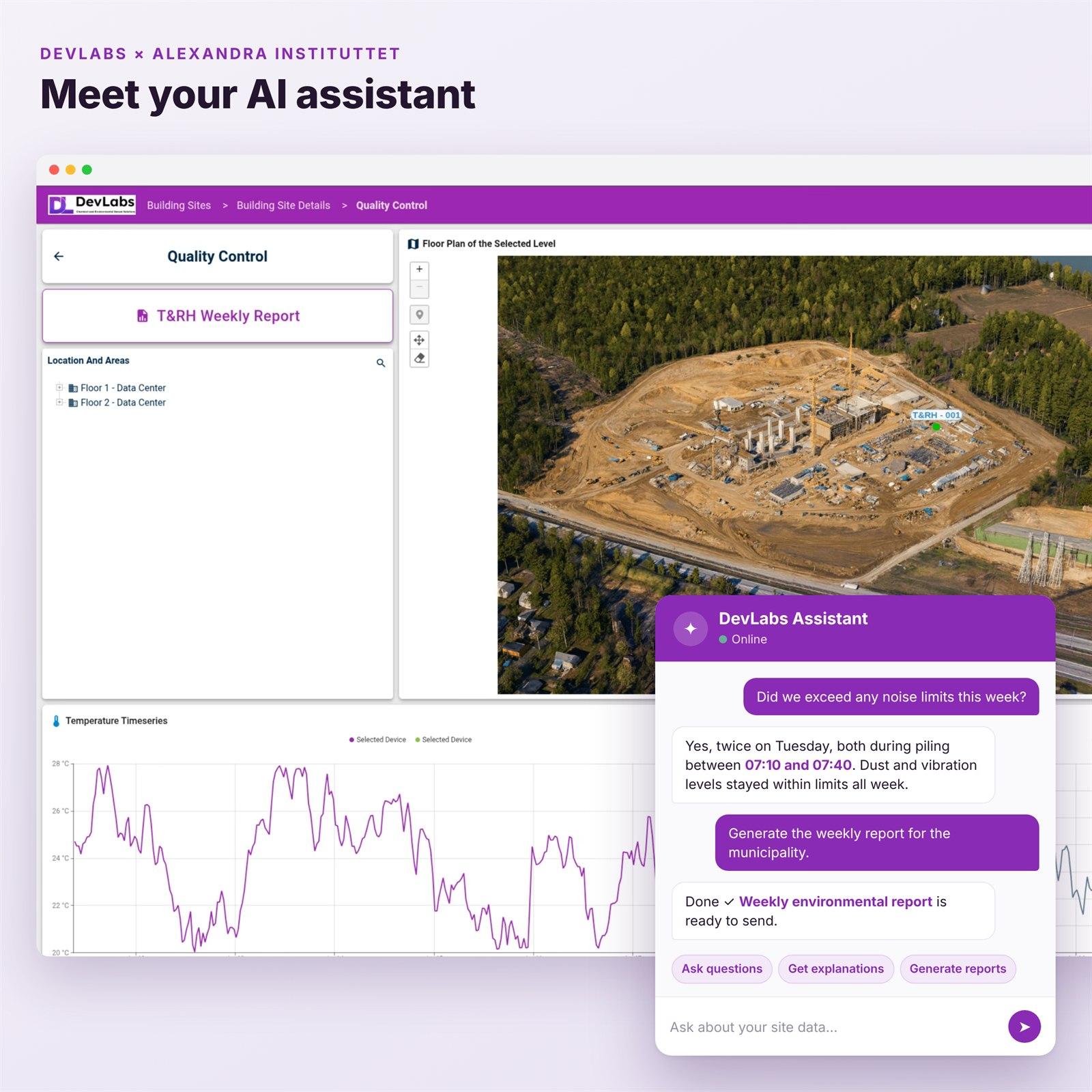
For construction sites in Denmark, requirements for measuring and limiting dust, noise, air quality and vibrations are nothing new. On most sites, the data itself is no longer the problem. Digital monitoring systems collect it continuously, at multiple points, around the clock. The challenge is what happens next.
The gap between data and action
Turning monitoring data into concrete action is still largely a manual process. Someone has to review the measurements, identify exceedances, work out what caused them, and compile the documentation required by authorities and stakeholders. That work is time-consuming, and because it depends on who does it and how, the quality of the documentation can vary from one report to the next.
The manual process also introduces delay. When an exceedance is only identified during the weekly review, the opportunity to act on it has often passed — and in the meantime, neighbouring properties may already have been affected.
An AI assistant built on existing site data
To address this, Devlabs and Alexandra Instituttet are developing Dash.DevLabs Copilot, an AI assistant integrated into the Dash.DevLabs environmental monitoring platform. The project is supported by a grant from WE BUILD DENMARK.
The assistant works directly on the data the platform already collects. Users can ask questions in plain language — whether a noise limit was exceeded during the week, or why vibration levels rose on a particular day — and receive precise answers and explanations. They can also generate reports for authorities and other stakeholders automatically, rather than assembling them by hand.
What the project will deliver
The collaboration has three central deliverables: a fully developed AI assistant integrated into the Dash.DevLabs platform, a set of standardised reporting templates, and a documented setup for the safe and controlled use of AI in a construction site context.
The last point matters. An assistant that summarises environmental data for regulatory reporting has to be transparent about how it reaches its answers and reliable enough that site teams can act on them. Alexandra Instituttet contributes research-based knowledge on the use of AI, including methods to ensure transparency, quality and reliable use. Devlabs is responsible for developing, integrating and testing the solution in practice.
Testing on active sites
The solution will be tested on active construction sites, where it has to demonstrate its value under real conditions rather than in a controlled setting.
The expected outcome is a significant reduction in the time spent on manual reporting, and faster, more consistent handling of deviations in the measurement data. Just as importantly, it should give everyone on site a better basis for understanding and responding to the data being collected.
The project also contributes to WE BUILD DENMARK's work to strengthen digitally supported innovation in the building and construction industry, by bringing AI into use directly on construction sites and connecting it to existing data infrastructure.
Interested in deploying a sensor system?
Get in touch — we scope projects and can deploy within weeks.
Contact us